Pearson's Correlation
This is my first article on my Correlation blog.
Hope you guys will like it.😃😃
Correlation coefficients are used to measure how strong a relationship is between two variables. There are several types of correlation coefficient, but the most popular is Pearson's.
Pearson’s correlation (also called Pearson’s R) is a correlation coefficient commonly used in linear regression. The full name is the Pearson Product Moment Correlation (PPMC).
If you’re starting out in statistics, you’ll probably learn about Pearson’s R first. In fact, when anyone refers to the correlation coefficient, they are usually talking about Pearson’s.
Correlation coefficient helps us to find how strong a relationship is between data. It gives both direction and strength of the relationship. This correlation works good with linear datasets.
Below is the formula for Pearson's Correlation :-

We can also write the above formula in the form of Z score.

The Formula returns the result in between -1 and 1, where:
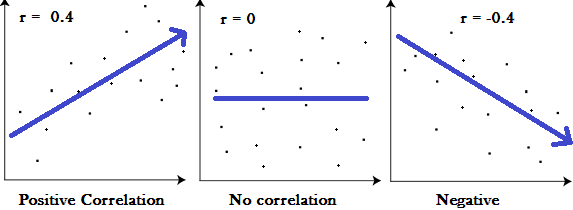
Key Points from the above image :-
- A correlation coefficient of 1 means that for every positive increase in one variable, there is a positive increase of a fixed proportion in the other. For example, shoe sizes go up in (almost) perfect correlation with foot length.
- A correlation coefficient of -1 means that for every positive increase in one variable, there is a negative decrease of a fixed proportion in the other. For example, the amount of gas in a tank decreases in (almost) perfect correlation with speed.
- Zero means that for every increase, there isn’t a positive or negative increase. The two just aren’t related.

Comments
Post a Comment